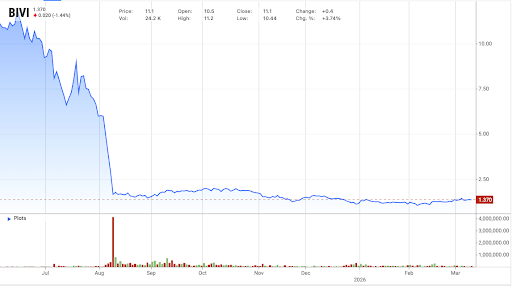
BioVie Inc. (NASDAQ: BIVI) is a clinical-stage biopharmaceutical company developing treatments for neurodegenerative diseases and advanced liver disease. Its lead asset, bezisterim (NE3107), is an orally available small molecule targeting neuroinflammation and insulin resistance, which are two of the principal biological drivers behind Parkinson's disease (PD), Alzheimer's disease (AD), and Long COVID. The company received a buy rating and $6 price target from Brookline Capital Markets in March 2025.
| Recent Price | $2.23 |
| Market Cap | $16.44M |
| 52-Week Range | $1.06 - $9.09 |
| Shares Outstanding | 7.54M |
| Volume | 44,622 |
| Float | $7.5M |
| Cash | $20.54M |
The Macro Backdrop: Big Money Is Moving Into Neuroscience
BioVie is entering a period when institutional appetite for central nervous system (CNS) assets is measurably growing. In January 2025, Johnson & Johnson (NYSE: JNJ) announced a $14.6 billion acquisition of Intra-Cellular Therapies (ITCI), calling neuroscience a core growth platform. That same year, Sanofi acquired Vigil Neuroscience for approximately $470 million to gain access to VG-3927, an oral small-molecule TREM2 agonist aimed at neuroinflammation in Alzheimer's, a mechanism that operates in overlapping biological territory to bezisterim. AbbVie (NYSE: ABBV) also acquired Aliada Therapeutics in late 2024 to expand its Alzheimer's and CNS pipeline.
These deals follow an earlier wave of neuroscience consolidation. Bristol Myers Squibb acquired Karuna Therapeutics for $14.0 billion (announced December 2023, closed March 2024); AbbVie acquired Cerevel Therapeutics for $8.7 billion (announced December 2023, closed August 2024); and Lundbeck acquired Longboard Pharmaceuticals for $2.6 billion (announced and closed in late 2024). Stifel analyst Paul Matteis, commenting on the Cerevel deal at announcement, wrote that it was "a big milestone for CNS companies" after a long wait for this kind of M&A. The NASDAQ Biotechnology Index finished 2025 up approximately 34%, closing near three-year highs.
The message from recent M&A activity is clear: large pharmaceutical companies are paying premiums for early CNS access, and the target profile of oral, small-molecule, neuroinflammation-focused assets matches bezisterim closely.
What Does BioVie Actually Do?
BioVie is a clinical-stage biopharmaceutical company developing bezisterim, an oral small-molecule drug, across three neurological indications: Parkinson's disease, Alzheimer's disease, and Long COVID. The common thread is neuroinflammation, chronic brain inflammation that bezisterim targets directly by selectively inhibiting ERK1/2 signaling and downstream NF-kB inflammatory pathways. Rather than treating symptoms after neurons have already been lost, bezisterim is designed to intervene upstream, before the damage occurs. BioVie is also developing BIV201, a separate asset targeting refractory ascites, a life-threatening complication of advanced liver cirrhosis.
Most approved Parkinson's drugs treat symptoms by increasing dopamine signaling, either by replacing dopamine (levodopa), mimicking it, or slowing its breakdown, addressing the deficit only after brain cells have already been lost. Bezisterim takes a different approach. Because it targets the neuroinflammation that drives neuron death in the first place, it could work for patients in early stages of the disease, or alongside existing treatments for patients who are further along, a flexibility that opens the door to a much larger patient population.
BioVie Therapeutics (NASDAQ: BIVI) is simultaneously advancing drug candidates across four indications, with several key data readouts on the horizon. The global Parkinson's disease drug market was valued at approximately $7.2 billion in 2024 and is projected to reach $13.34 billion by 2032 (Source: Yahoo Finance). BioVie's addressable opportunity in PD is estimated at more than $3 billion in annual U.S. peak sales at 10% market penetration, per Brookline Capital Markets.
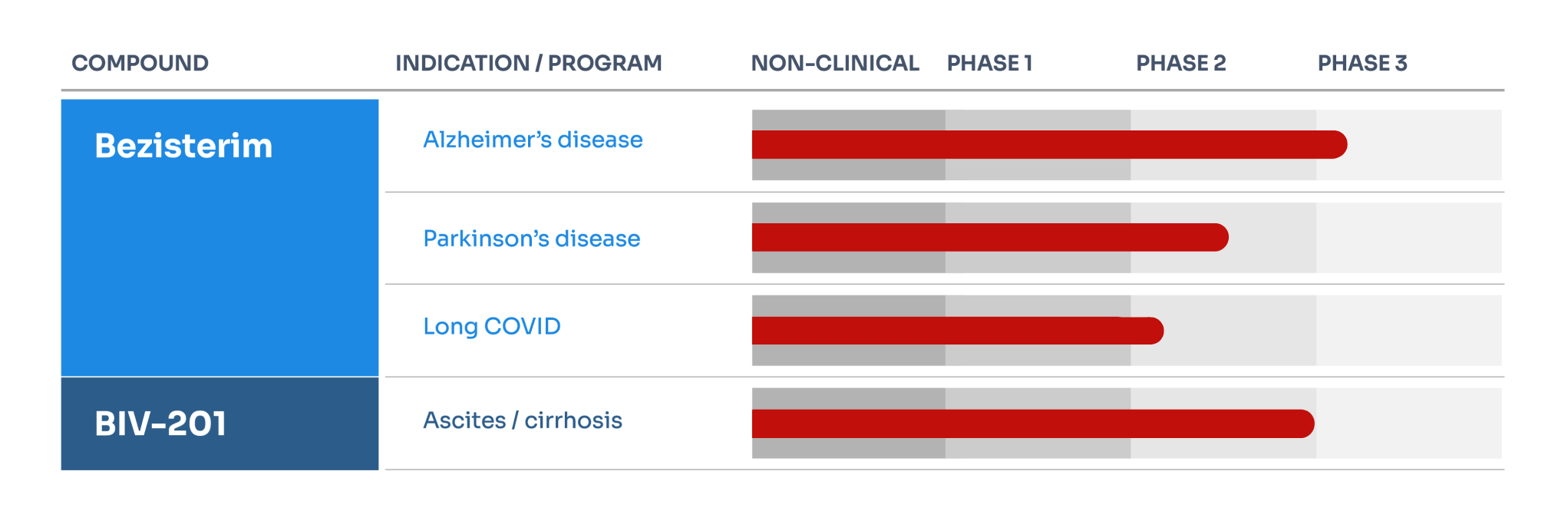
BioVie Therapeutics (NASDAQ: BIVI) is simultaneously advancing drug candidates across four indications, with several key data readouts on the horizon. (Source: BioVie Inc.)
Because bezisterim targets neuroinflammation, a mechanism implicated across multiple neurodegenerative conditions, the same drug being studied in Parkinson's is also being investigated in Alzheimer's disease and Long COVID. Alzheimer's represents an even larger prize, a $30 billion-plus U.S. annual market opportunity, while Long COVID, which affects an estimated 17 million adults in the United States, adds a third front.
BioVie is also developing BIV201 as a continuous infusion formulation of terlipressin for refractory ascites, a life-threatening buildup of abdominal fluid caused by advanced liver cirrhosis that currently has no FDA-approved treatment in the United States. Phase 2b data demonstrated a 53% reduction in ascites volume versus standard of care (p<0.001). The U.S. commercial opportunity for BIV201 is estimated at $1.6 billion annually.
The Clinical Data
In a completed Phase 2 trial in Parkinson's patients, 88.9% of those treated with bezisterim alongside levodopa achieved more than 30% improvement in motor control scores at two hours post-dose, versus 63.6% of patients on levodopa alone. Perhaps the most striking single finding: 30% of bezisterim-treated patients showed no pathological PD symptoms whatsoever prior to receiving their morning levodopa dose, a result seen in none of the placebo patients. The drug has shown a clean safety profile across all studies to date, with no serious drug-related adverse events reported.
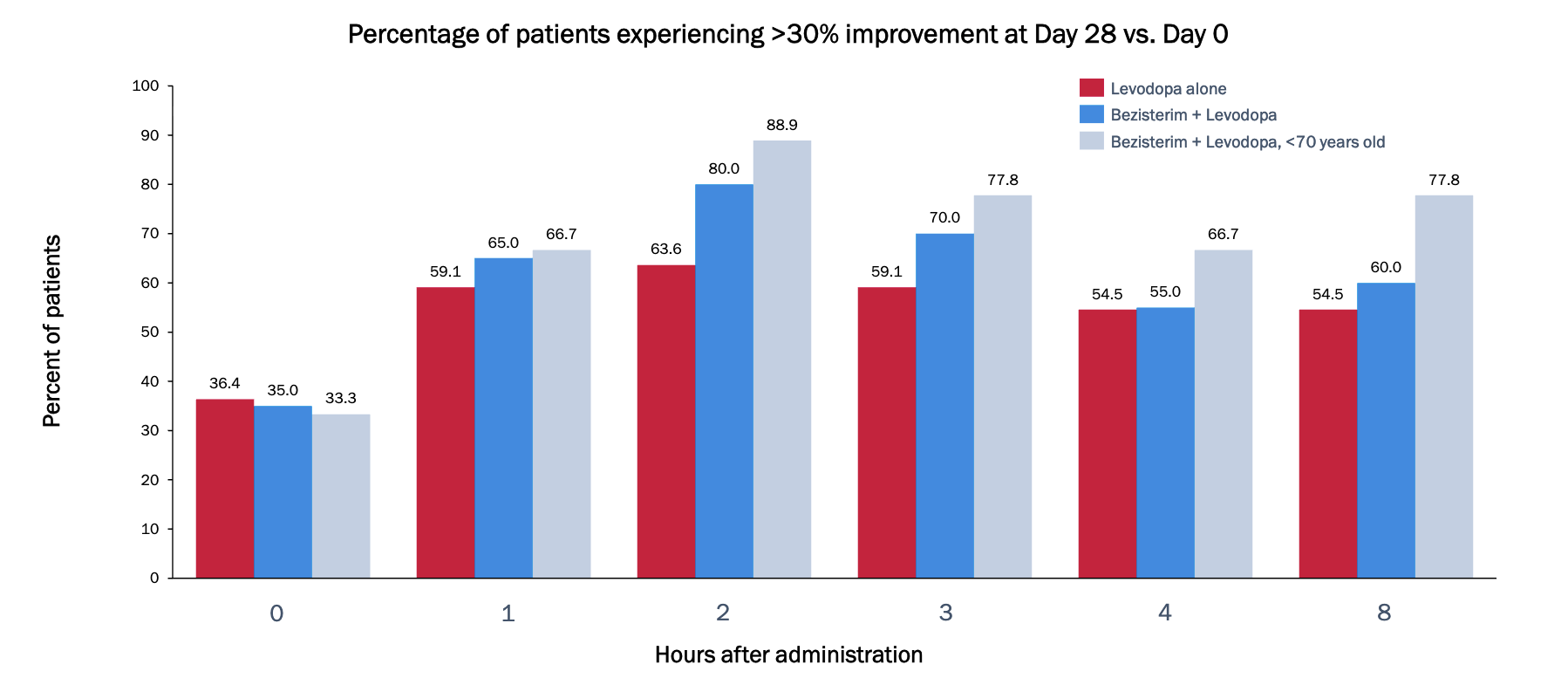
Source: Biovie Inc.
In Alzheimer's, a 2023 Phase 3 trial was rendered inconclusive by site-level protocol deviations that excluded 358 out of 439 enrolled patients from the primary analysis — a logistical setback, not a biological one. However, in the remaining 81-patient evaluable population, all cognitive and functional measures numerically favored bezisterim, with no new safety signals. The impacted sites were referred to the FDA's Office of Scientific Investigations, and the review is ongoing. Brookline's analyst concluded these complications appear isolated to the AD program and do not impair the PD development thesis.
For context, the inconclusive Alzheimer's readout is not as discouraging as it may first appear and is actually far from isolated in the broader AD landscape. Athira Pharma's Phase 2/3 LIFT-AD trial of fosgonimeton, which enrolled 312 mild-to-moderate AD patients, missed its primary endpoints in September 2024, with Athira's CMO explicitly attributing the result to the lack of clinical decline in the placebo group, an increasingly recognized design challenge in short-duration AD trials. Similarly, Annovis Bio's (ANVS) Phase 2/3 AD study reported unexpected placebo performance. Both cases reflect a broader pattern: standard-duration AD trials are increasingly confounded by unusually stable placebo arms, a problem that has nothing to do with drug activity.
More importantly, what the evaluable data actually showed was encouraging. In the 81-patient population not affected by the site-level protocol deviations, all cognitive and functional measures numerically favored bezisterim, with no new safety signals making it a meaningful signal given the circumstances. That positive directional trend was further reinforced by data presented at the 2025 World Conference on Aging and Gerontology, where bezisterim-treated patients experienced statistically significant biological age deceleration across multiple epigenetic aging clocks compared to placebo. That finding has attracted its own investor attention in the longevity medicine space, particularly given broader interest in companies like Anavex Life Sciences (AVXL), CervoMed (CRVO), Cognition Therapeutics (CGTX), and Annovis Bio (ANVS) working at the intersection of neuroinflammation and neurodegeneration.
Brookline Models Bezisterim Reaching Approximately $839 Million in Peak Sales by 2035, With SUNRISE-PD Topline Data the Next Major Catalyst
Brookline's $6 price target, established in its March 2025 initiation report, reflects $5 per share from the bezisterim opportunity in Parkinson's disease and $1 per share from BioVie's cash position. The model assumes a $40,000 annual list price, 10% market penetration among eligible patients, and initial revenues beginning in 2031 at approximately $126 million, scaling to peak revenues of approximately $839 million by 2035. Notably, this valuation is built entirely on the Parkinson's indication. It ascribes no value to the Alzheimer's, Long COVID, or ascites programs, each of which represents a separate and potentially significant source of upside not reflected in the analyst's base case.
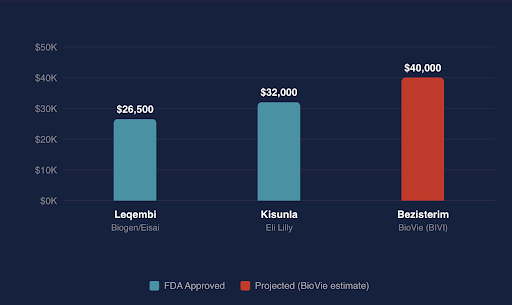
Annual treatment cost comparison: Leqembi (lecanemab), Kisunla (donanemab), and bezisterim (projected) — Source: Biogen/Eisai, Eli Lilly, Brookline Capital Markets estimates
That $40,000 list price assumption is conservative relative to existing precedent. Biogen and Eisai's Leqembi (lecanemab), approved in 2023, launched at approximately $26,500 per year; Eli Lilly's Kisunla (donanemab), approved in 2024, launched at approximately $32,000. Both are intravenous infusion therapies requiring biweekly or monthly clinic visits, and both carry meaningful ARIA (amyloid-related imaging abnormality) risk. Approximately 21% of Leqembi patients and roughly 40% of Kisunla patients develop some form of ARIA, including brain swelling or microhemorrhage, with monitoring requiring regular MRI. An oral, anti-inflammatory therapy that avoids the ARIA mechanism entirely, requires no infusion infrastructure, and has reported no serious drug-related adverse events across all studies to date would have concrete differentiation arguments on both safety and access, particularly for patients in rural settings or those unable to maintain biweekly infusion schedules.
The next significant data event is the SUNRISE-PD Phase 2 trial. BioVie completed enrollment of 60 treatment-naive early Parkinson's patients in January 2026, and topline results are expected in the first half of 2026. The trial tests bezisterim as a monotherapy, with the rationale grounded in the earlier Phase 2 finding that 30% of bezisterim-treated patients were symptom-free before their morning levodopa dose, a signal attributable to bezisterim alone given levodopa's short half-life.
A positive SUNRISE-PD readout would meaningfully strengthen the case for pivotal development and could attract partnership interest. The market response to comparable data readouts in this peer group has been measurable. In the Parkinson's space specifically, Annovis Bio (ANVS) jumped 33% premarket on March 16, 2021 after releasing interim Phase 2a data showing improved speed and coordination scores in PD patients, a 54-patient study that subsequently supported the company's progression to Phase 3. ANVS shares meaningful profile overlap with bezisterim as an oral small molecule targeting neuroinflammation in PD, and SUNRISE-PD is a substantially larger, fully enrolled trial with topline data expected in the first half of 2026.
BioVie's $6 Target Is Driven Primarily by Bezisterim's Parkinson's Opportunity, While Long COVID, Alzheimer’s, and Refractory Ascites Programs Provide Additional Potential Upside
Beyond SUNRISE-PD, BioVie has a Phase 2 trial for Long COVID underway, with 208 patients enrolled, funded by a $13.1 million non-dilutive award from the Department of Defense secured in April 2024. The DoD investment reflects a broader federal commitment to this space: NIH has allocated over $1.8 billion to Long COVID research through its RECOVER initiative since 2020, including a $515 million infusion in February 2024 and an additional $662 million appropriation later that year, with the National Institute of Neurological Disorders and Stroke (NINDS) as a named co-leader of that program.
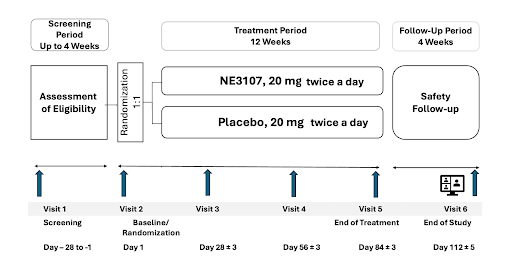
Trial Design for Bezisterim in Long-COVID (Source: BioVie Inc)
Brookline's price target does not incorporate value from the Long COVID program, a potential Phase 3 in Alzheimer's, or refractory ascites. Each represents incremental upside not in the base case.
Team Behind the Science
BioVie is led by Cuong Do, who serves as President and CEO. Do previously served as Chief Strategy Officer at Merck & Co., where he contributed to the development of Keytruda, the blockbuster cancer immunotherapy that became one of the best-selling drugs in the world and a defining example of what targeted biological intervention can achieve at scale. He also served as President of Samsung Global Strategy Group, bringing a rare combination of big-pharma execution and global strategic experience to a company at an inflection point.
Chief Medical Officer Joseph Palumbo, M.D., brings prior CMO experience at Zynerba Pharmaceuticals and senior roles at Mitsubishi Tanabe Pharma and Johnson & Johnson. Regulatory affairs are led by Chief Regulatory Officer David Morse, Ph.D., who spent years as an Associate Director at the FDA, giving BioVie a meaningful edge as it navigates the path from Phase 2 toward pivotal development. The board includes Jim Lang, founder and CEO of EVERSANA, one of the largest commercial partners in the biopharma industry, and Michael Sherman, J.D., a 30-year investment banking veteran whose healthcare finance experience spans Neurocrine Biosciences, Teva, Amgen, and Merck.
The Investment Argument
BIVI's market capitalization is currently $10.56 million, below the company's most recently reported cash position of approximately $20.54 million, implying a negative enterprise value on current metrics. With SUNRISE-PD enrollment complete and topline data expected in the first half of 2026, the company is approaching its most significant catalyst to date. The DoD Long COVID trial and the Alzheimer's and ascites programs represent additional pipeline depth that the current valuation does not reflect. For investors willing to accept binary clinical risk, the current entry point offers asymmetric upside relative to the underlying asset value.
Disclosure
RedChip Companies, Inc. research reports, company profiles and other investor relations materials, publications or presentations, including web content, are based on data obtained from sources we believe to be reliable but are not guaranteed as to accuracy and are not purported to be complete. As such, the information should not be construed as advice designed to meet the particular investment needs of any investor. Any opinions expressed in RedChip reports, company profiles, or other investor relations materials and presentations are subject to change. RedChip Companies and its affiliates may buy and sell shares of securities or options of the issuers mentioned on this website at any time.
The information contained herein is not intended to be used as the basis for investment decisions and should not be construed as advice intended to meet the particular investment needs of any investor. The information contained herein is not a representation or warranty and is not an offer or solicitation of an offer to buy or sell any security. To the fullest extent of the law, RedChip Companies, Inc., our specialists, advisors, and partners will not be liable to any person or entity for the quality, accuracy, completeness, reliability or timeliness of the information provided, or for any direct, indirect, consequential, incidental, special or punitive damages that may arise out of the use of information provided to any person or entity (including but not limited to lost profits, loss of opportunities, trading losses and damages that may result from any inaccuracy or incompleteness of this information).
Stock market investing is inherently risky. RedChip Companies is not responsible for any gains or losses that result from the opinions expressed on this website, in its research reports, company profiles or in other investor relations materials or presentations that it publishes electronically or in print.
We strongly encourage all investors to conduct their own research before making any investment decision. For more information on stock market investing, visit the Securities and Exchange Commission ("SEC") at www.sec.gov. and/or the Ontario Securities Commission (“OSC”) at www.osc.gov.on.ca.
BioVie (BIVI) is a client of RedChip Companies, Inc. BIVI agreed to pay RedChip Companies, Inc., a $7,500 monthly cash fee, beginning in March 2022, for 12 months of RedChip investor awareness services. The CEO of RedChip Companies owns 3,150 shares of BIVI. BIVI also agreed to pay RedChip a $50,000 fee for a national TV ad campaign aired weekdays from June 17 through July 1, 2024 and October 21 to October 25, 2024, and a $37,500 fee plus 45,000 shares of Rule 144 stock for a national TV ad campaign aired May 1 to May 14, 2025. RedChip intends to and will, if possible, sell all of its shares immediately upon removal of the restriction, and you may be buying as RedChip is selling.
Investor awareness services and programs are designed to help small-cap companies communicate their investment characteristics. RedChip investor awareness services include the preparation of a research profile(s), multimedia marketing, and other awareness services.